
Place Bet Horse Racing UK — Rules, Payouts & Strategy
 Available in US
Every place term explained. Every payout calculated.
A place bet in UK horse racing pays out when your horse finishes in a designated position. This guide covers every UK place term under Tattersalls rules, walks through payout calculations with real numbers, and grounds each strategy in data from the BHA, the Gambling Commission and the HBLB.

A place bet in UK horse racing is a wager on a horse to finish in one of the designated paying positions — typically the top two, three or four, depending on the number of runners and whether the race is a handicap. It is, by some distance, the most misunderstood bet on the card. Punters who grasp the mechanics of the place bet in horse racing gain access to a market where the strike rate is meaningfully higher than win betting, and where the right strategy can turn that frequency into long-term profit.
Horse racing is not some niche pursuit in Britain. It is the country's second largest spectator sport behind football, with direct revenues exceeding £1.47 billion and a total annual economic contribution of £4.1 billion, supporting more than 85,000 jobs across 59 licensed racecourses. According to the Gambling Commission's latest participation survey, 47% of UK adults engaged in some form of gambling between April and July 2025 — and horse racing remains one of the core verticals driving that figure. The sport is deeply embedded in the national calendar, from the steeplechasing winter through to the Flat season's summer crescendo, and place betting sits at the heart of how millions of those punters interact with it.
Yet most guides to place betting online read like the same terms-and-conditions page copy-pasted across a dozen bookmaker blogs. They tell you a place bet exists. They neglect to tell you why the place fraction changes from 1/4 odds to 1/5 odds depending on field size, or how shrinking field sizes across British racing are directly affecting how many places your bookmaker will pay. They skip the maths entirely, and they certainly do not mention that the betting environment around horse racing is, as BHA Director of Racing Richard Wayman noted in the 2025 Racing Report, one where "the horse population continues to decline and the betting environment remains challenging."
This guide is built differently. It collects the complete UK place terms table under Tattersalls rules, walks through payout calculations step by step with real numbers, and grounds every strategic recommendation in verifiable data from the BHA, the Gambling Commission and the Horserace Betting Levy Board. Whether you are placing your first place bet ahead of this spring's festival season or refining a systematic approach that already tracks strike rates and yield by field size, the structure here is designed to be used, not just read.
What Every UK Punter Should Know About Place Betting
- A place bet pays out when your horse finishes in a designated position — top two (5–7 runners), top three (8+ runners) or top four (16+ handicaps) — with place fractions of either 1/4 or 1/5 the win odds depending on field size and race type.
- Average UK field sizes in 2025 were 8.90 (Flat) and 7.84 (Jumps), meaning most races offer three paying places. Target larger fields — especially Premier handicaps averaging 11+ runners — for four-place terms and better value.
- Favourites win roughly 30% of Jump races but finish in the places around 58% of the time at the Grand National, making place-only bets on market leaders a statistically defensible approach in big-field events.
- Horse racing betting participation nearly doubles in the spring festival season (7%) compared to winter (4%), and bookmaker promotions — extra places, Best Odds Guaranteed — peak accordingly. Timing matters.
- Always use UKGC-licensed operators. An estimated £4.3 billion is wagered annually on the UK black market, with none of the consumer protections that licensed betting provides.
UK Place Terms — How Many Places Are Paid Out
Place terms in UK horse racing are not arbitrary. They follow a codified structure rooted in Tattersalls Rule 3 — the settlement framework that has governed on-course and off-course betting for over a century. Every bookmaker licensed by the UKGC applies these standard terms as a baseline, though some will enhance them through promotions. Understanding the five categories below is the single most important thing a place bettor can do before risking a penny.

The Standard Place Terms Table
| Number of Runners | Race Type | Places Paid | Place Fraction |
|---|---|---|---|
| 1–4 | Any | None (win only) | N/A |
| 5–7 | Any | 1st, 2nd | 1/4 odds |
| 8+ | Non-handicap | 1st, 2nd, 3rd | 1/5 odds |
| 12–15 | Handicap | 1st, 2nd, 3rd | 1/4 odds |
| 16+ | Handicap | 1st, 2nd, 3rd, 4th | 1/4 odds |
Source: Tattersalls standard terms via grandnational.fans.
What the Table Means in Practice
The table above looks simple enough. Five rows, four columns. But the distinctions between those rows shape every place bet you will ever make, so it is worth unpacking each one.
1–4 runners: No place market exists. With a field this small, bookmakers offer win-only terms. If you attempt to place an each-way bet on a four-runner race, most operators will either void the place part or treat the entire bet as a win-only wager. Always check before confirming your bet slip.
5–7 runners: Two places are paid at 1/4 of the win odds. This is the tightest set of place terms you will encounter. In a seven-runner Group 1 race — which is not uncommon on Flat — your horse needs to finish in the top two. The 1/4 fraction is more generous than the 1/5 you get in larger non-handicap fields, which partially compensates for the difficulty of landing just two paying positions.
8+ runners (non-handicap): Three places at 1/5 odds. This is where most standard Flat races and championship Jumps contests sit. The average field size across British Flat racing in 2025 was 8.90 runners, and for Jumps it was 7.84 — both slightly down on 2024 figures of 9.14 and 8.49 respectively, reflecting the continued decline in the UK horse population, which fell 2.3% to 21,728 horses in training. The narrowing fields mean that a greater proportion of races hover around the 7–8 runner boundary where place terms shift.
12–15 runners (handicap): Three places at 1/4 odds. Handicaps are the bread and butter of place betting. The larger the field, the more competitive the race, and the more places become available. At 12–15 runners you still get three places, but the fraction improves to 1/4 — a meaningful upgrade from the 1/5 you receive in a non-handicap with the same runner count.
16+ runners (handicap): Four places at 1/4 odds. These are the flagship events — the big-field handicaps at Cheltenham, Aintree, Ascot and the major Saturday cards. With four paying positions and 1/4 the win odds, the place market here offers the widest safety net and the most generous fractions available under standard terms. It is no coincidence that these are also the races where bookmakers compete hardest with extra-place promotions.
The boundary between 7 and 8 runners is the most consequential threshold in place betting — it determines whether you get two places or three. With average field sizes continuing to shrink, checking the declared runners before you bet has never been more important.
How Place Bet Payouts Are Calculated in the UK
Place bet payouts follow a formula that is straightforward once you have seen it in action, but oddly difficult to find written out clearly anywhere. The core calculation is:
Payout = Stake × (Odds × Place Fraction) + Stake
The first part — Stake × (Odds × Place Fraction) — gives you the profit. Adding the returned stake gives the total payout. The place fraction, as we covered, is either 1/4 or 1/5 depending on the field and race type. Those two fractions create a significant difference in returns, and confusing them is one of the most common errors in place betting.

Worked Example 1 — Small Field, 1/4 Odds
7 runners, non-handicap. Your horse is 8/1. Stake: £10.
Place terms: 2 places at 1/4 odds.
Place odds = 8/1 × 1/4 = 2/1.
Profit = £10 × 2 = £20.
Total payout = £20 + £10 stake = £30.
At 2/1 effective place odds, your £10 returns £30 if the horse finishes first or second. The 1/4 fraction here is the more generous of the two standard fractions, which compensates for the fact that only two places are on offer.
Worked Example 2 — Standard Field, 1/5 Odds
10 runners, non-handicap. Your horse is 10/1. Stake: £10.
Place terms: 3 places at 1/5 odds.
Place odds = 10/1 × 1/5 = 2/1.
Profit = £10 × 2 = £20.
Total payout = £20 + £10 stake = £30.
Identical payout to the first example — but the dynamics are different. You have three places instead of two, which raises the probability of collecting. The 1/5 fraction produces lower odds per unit of win price, but the extra place compensates. This trade-off is the central tension in place betting arithmetic: more places paid, but at a thinner fraction.
Worked Example 3 — Big-Field Handicap, 1/4 Odds on 4 Places
18 runners, handicap. Your horse is 14/1. Stake: £10.
Place terms: 4 places at 1/4 odds.
Place odds = 14/1 × 1/4 = 7/2.
Profit = £10 × 3.5 = £35.
Total payout = £35 + £10 stake = £45.
This is where place betting in UK horse racing becomes genuinely attractive. Four paying positions combined with 1/4 odds — the same generous fraction you get in a 5–7 runner field, but with double the places. A 14/1 shot finishing fourth in a big-field handicap returns £45 for a £10 stake. The same horse at 1/5 odds (which does not apply here, but hypothetically) would return just £38.
As HBLB Chief Executive Alan Delmonte noted when reviewing the 2024/25 figures, bookmaker-friendly results at events like the Cheltenham Festival can cause significant swings in operator profitability — "the last two months, February and March 2025, saw bookmakers' gross profits well above recent norms." That volatility cuts both ways. When favourites oblige in big fields, the place market pays out heavily. When outsiders fill the frame, the bookmakers clean up. Understanding the maths puts you on the right side of that equation more often.
The difference between 1/4 and 1/5 odds on a 10/1 shot is £5 on a £10 stake. Over 100 bets, that is £500. Always know which fraction applies before placing your bet.
Place Bet vs Each-Way — When to Choose Which
The distinction between a place bet and an each-way bet is the source of more confusion — and more wasted money — than any other concept in UK horse racing. They are related, but they are not the same thing, and treating them interchangeably is a costly habit.
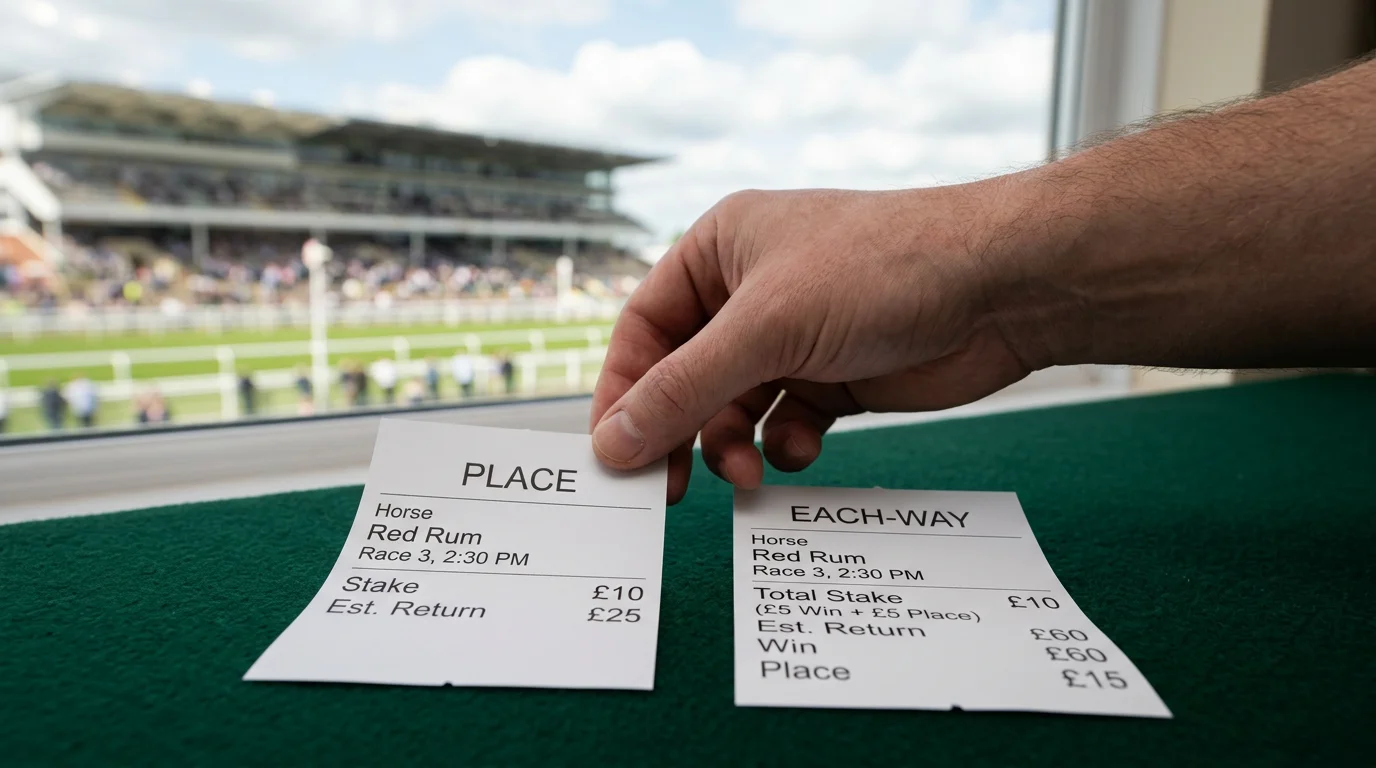
A place-only bet is a single wager on your horse to finish in the places. One stake, one outcome. If the horse places, you collect at the place fraction of the win odds. If it does not, you lose your stake. That is the full extent of it.
An each-way bet is two bets in one: a win bet and a place bet, each at the same stake. If you bet £10 each-way, your total outlay is £20 — £10 on the win, £10 on the place. If the horse wins, both parts pay out. If it places but does not win, you lose the £10 win stake and collect only on the £10 place part. If it finishes out of the places entirely, you lose the full £20.
Comparing the Outcomes
| Outcome | Place Only (£10 stake) | Each-Way (£10 E/W = £20 total) |
|---|---|---|
| Horse wins (8/1, 3 places, 1/5 odds) | +£16 (place part only) | +£96 (£80 win + £16 place) |
| Horse places (not win) | +£16 | +£6 (£16 place profit + £10 stake back − £20 total outlay) |
| Horse unplaced | −£10 | −£20 |
The table reveals the fundamental trade-off. Each-way captures the full upside when a horse wins — the win part at full odds plus the place part — but it costs twice as much. On a horse that places without winning at 8/1, the each-way bettor scrapes a small profit of £6, whereas the place-only bettor nets £16 from a single £10 stake. At shorter odds — say 4/1 with 1/5 place fractions — the each-way bettor would actually finish at a net loss on a placing, because the place return no longer covers the doubled stake. The place-only bettor, by contrast, profits on every placing regardless.
When Place-Only Makes More Sense
If you believe a horse has a strong chance of finishing in the places but a limited chance of winning outright, place-only is the sharper bet. This is particularly true for consistent performers in big-field handicaps — the type of horse that finishes third or fourth race after race but rarely breaks through. Backing this profile each-way means half your stake is effectively dead money on the win part. Place-only lets you concentrate your entire stake on the outcome you actually expect.
When Each-Way Earns Its Double Stake
Each-way comes into its own when you have identified a horse at a price that genuinely can win but is also very likely to place. The sweet spot is typically a horse between 6/1 and 16/1 in a competitive race with three or four paying places. At those odds, the win part delivers substantial returns if everything goes right, while the place part provides a safety net. Below 6/1, the each-way payout on a placing is often so thin that the doubled stake is hard to justify — you are paying twice for marginal insurance.
Each-way is not a "safer" version of a win bet. It is a more expensive one. Use it when the win is a realistic prospect at decent odds. Use place-only when you are targeting consistency over a single large payout.
Place Bet Strategies That Work in UK Horse Racing
Strategy in place betting is not about hunches or lucky numbers. It is about identifying structural edges — situations where the probability of a horse placing exceeds what the odds imply. Three approaches stand out when measured against recent data from British racing.
Backing Favourites to Place in Big Fields
The most statistically robust place betting strategy is also the least glamorous: backing market favourites in races with large fields. The numbers from geegeez.co.uk's analysis of Grand National trends are instructive. Over the last decade, favourites have won roughly 24% of Grand Nationals — but they have finished in the top four 58% of the time. Across Jump racing more broadly, the favourite wins approximately 30% of all races.
That gap between win rate and place rate is the entire foundation of place betting strategy. A horse priced at 3/1 in a 16+ runner handicap might return only modest place odds at 1/4 of 3/1 (effectively 3/4, meaning 75p profit per £1 staked). But if that horse places 58% of the time, the maths works. Over 100 such bets at £10 each, you collect 58 times at £17.50 (£10 × 0.75 + £10 stake) for total returns of £1,015, against a total outlay of £1,000. It is thin, but it is positive — and it compounds if you can identify races where the favourite's place probability exceeds the market average.
Targeting Premier Races and Festival Cards
Not all races are equal for place bettors. The BHA's 2025 Racing Report revealed a telling split: while overall betting turnover per race fell by 4.3% year-on-year, average turnover on Premier-category races actually rose by 1.1%. Premier races — the highest-graded fixtures in British racing — attract bigger fields, better-quality horses and, critically, more competitive betting markets.
Bigger fields mean more paying places. A Premier handicap with 16+ runners offers four places at 1/4 odds. An ordinary midweek handicap at a smaller track might struggle to attract 12 runners, dropping you to three places. The strategy is not complicated: concentrate your place betting on the cards that draw the deepest fields. In 2025, Premier Flat races averaged 11.02 runners per race, compared to 8.90 across all Flat racing. Premier Jumps races averaged 9.41 versus 7.84 overall. Those extra two or three runners per race can be the difference between three and four paying places.
Seasonal Timing — Betting When Participation Peaks
Horse racing betting has a pronounced seasonal rhythm. According to the Gambling Commission's participation survey, 7% of UK adults bet on horse racing during the April-to-July window in 2025, compared with just 4% in the January-to-April period. That 75% increase in participation coincides with the spring festival season — Cheltenham in March, Aintree in April, the Guineas in May, Royal Ascot in June.
Why does this matter for place bettors? The influx of recreational money during festival season does two things. First, it pushes bookmakers to offer more aggressive promotions — extra places, enhanced odds, Best Odds Guaranteed — to capture that seasonal traffic. Second, it can create inefficiencies in the place market as casual bettors back horses on sentiment rather than form, potentially inflating or deflating prices in ways that a systematic bettor can exploit. The spring window is not just when more people bet on racing. It is when the place betting market offers its richest terms.
Focus on Premier handicaps with 16+ runners during the spring festival season. This combination — big fields, four places at 1/4 odds, enhanced bookmaker promotions and inflated markets — represents the highest-value environment for place betting in the UK calendar.
Place Betting at the UK's Biggest Racing Festivals
Three festivals define the place betting calendar in British horse racing. Each has its own field sizes, place terms and strategic considerations, and understanding those differences is worth more than any number of tips columns.
Grand National — Aintree
The Grand National is the single biggest betting race in Britain and one of the biggest in the world. According to Entain data, the 2025 edition was expected to generate over £200 million in betting turnover, with the full Aintree Festival surpassing £250 million. To put that in context, the Grand National generates approximately 700% more betting activity than the next most popular race, the Cheltenham Gold Cup. Greg Ferris, Managing Director of Sports at Entain, has described the race as a "cultural phenomenon that transcends sports" — and the betting figures support that characterisation.
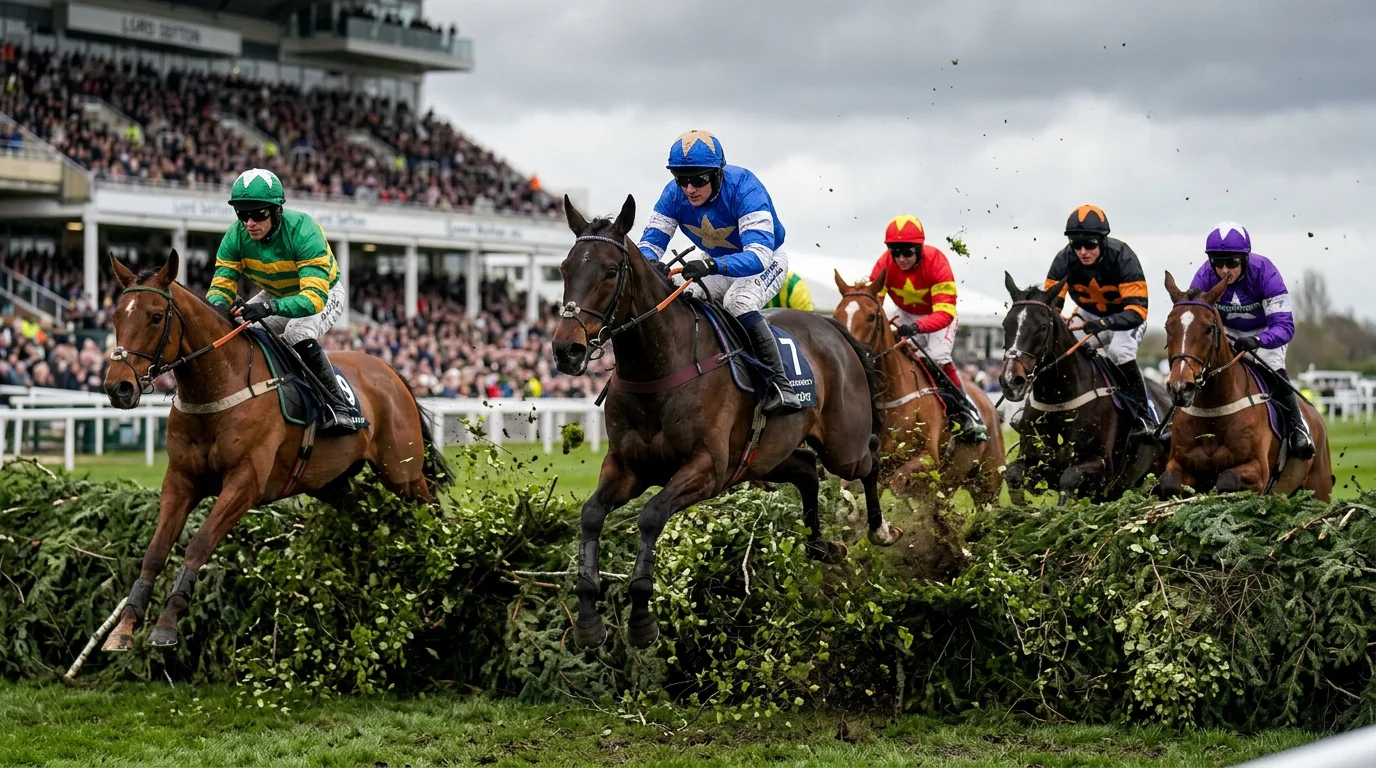
With a maximum field of 34 runners, the Grand National operates under exceptional place terms. Standard bookmaker terms typically pay six or even seven places — well beyond the four places offered under standard Tattersalls rules for 16+ handicaps. Many operators extend this further through extra-place promotions, paying eight or more places around the race. The audience is similarly unique: more than 600 million viewers across 140 countries, and roughly half of the race's betting revenue comes from occasional punters staking £5 or less — with 30% of Grand National bettors making their first deposit of the year specifically for this race. For place bettors, the Grand National offers the widest safety net of any race in the calendar, but the sheer field size and the unpredictability of four miles two and a half furlongs and 30 fences demand a careful selection approach.
Cheltenham Festival
Cheltenham is the place bettor's four-day laboratory. Twenty-eight races across the festival, split between championship contests (typically 8–14 runners) and handicaps that can attract 20+ runners. The betting volumes are enormous: William Hill projected approximately £450 million in total wagering across the 2026 Cheltenham Festival. As Grainne Hurst, CEO of the Betting and Gaming Council, put it, the Grand National "is the nation's punt" — but Cheltenham is the nation's four-day examination of form, and the place market here rewards those who have done their homework.
The distinction between championship and handicap races at Cheltenham is critical for place terms. A Champion Hurdle with 10 runners offers three places at 1/5 odds. A Coral Cup handicap with 24 runners offers four places at 1/4 odds — plus potential extra places from bookmakers competing for festival business. Experienced place bettors often concentrate on the big-field handicaps, where the mathematics of four places at 1/4 odds are most favourable.
Royal Ascot
Royal Ascot is the premier Flat festival, and it brings a different dynamic to place betting. Field sizes in the Heritage handicaps — the Royal Hunt Cup, the Wokingham, the Buckingham Palace Stakes — regularly exceed 20 runners, triggering four-place terms at 1/4 odds. The quality of these fields is exceptionally deep, making outright winners difficult to find but placers more predictable for those who study the form. The BHA reported record total prize money of £194.7 million across British racing in 2025, with Royal Ascot contributing a significant share — an investment that attracts the best horses and the most competitive fields.
For place bettors, Royal Ascot's Heritage handicaps offer arguably the best structural value of any races in the Flat calendar. Large fields, 1/4 odds, four places, and a parade of bookmaker promotions designed to attract the summer racing crowd. The strategic approach mirrors that of Cheltenham's big-field handicaps: identify horses with strong place form on the relevant going, and let the maths of four places do the heavy lifting.
UK Horse Racing Betting Market — Where Place Bets Fit
Understanding the broader market that place betting sits within helps explain why certain trends — shrinking promotions, shifting place terms, fewer extra-place offers — are happening now and what to expect through 2026 and beyond.
The Gambling Commission's annual report for the financial year ending March 2025 recorded gross gambling yield from remote horse racing betting at £766.7 million. That figure represents a slight dip from £771.1 million the previous year, but remains above the £733.5 million recorded in 2022/23. Horse racing is not collapsing — but it is not growing either, and the detail beneath the headline number tells a more concerning story.
The HBLB's Annual Report for 2024/25 documented that average betting turnover per race has fallen for three consecutive years: down 8% year-on-year, 15% over two years, and 19% over three years. Punters are not necessarily betting less in total, but they are spreading their money across more races or migrating to other sports. Anne Lambert, Interim Chair of the HBLB, confirmed this trajectory while noting that the Levy — the statutory contribution from bookmakers to fund racing — reached a record £108.9 million in 2024/25, up from £105.3 million the previous year.
The apparent contradiction — falling turnover but rising Levy — is explained by the relationship between GGY and the Levy formula. When bookmaker results are strong (more punters lose), GGY rises and so does the Levy, even if total amounts staked are declining. It is a paradox that benefits the racing industry in the short term but raises questions about the long-term health of the betting market.
Racecourse attendance, at least, is heading in the right direction. The BHA reported 5.031 million visitors to UK racecourses in 2025 — the first time the figure has exceeded five million since 2019, representing a 4.8% increase on 2024. Racing is drawing people through the gates. The challenge is converting that footfall into sustained betting activity, particularly in the place and each-way markets where the sport has traditionally built its broadest customer base.
For place bettors, the market dynamics create a mixed picture. Falling turnover per race puts pressure on bookmakers to tighten terms and reduce promotional generosity. But the record Levy funding is being reinvested in prize money and fixture quality, which in turn supports the Premier-grade meetings where place betting conditions are most favourable. The place market is not expanding, but the races where it works best are being protected. As HBLB Chief Executive Alan Delmonte put it in the 2024/25 Annual Report, "if racing is to continue to be a leading sport and leisure activity, it needs to ensure that it is presented and structured in a way that is attractive to the modern consumer."
Responsible Gambling — Betting Safely on UK Horse Racing
No guide to place betting is complete without addressing the environment in which those bets are made — and in 2026, that environment includes a significant and growing illegal gambling market that every UK punter should be aware of.
A 2024 report by Frontier Economics, commissioned by the Betting and Gaming Council, estimated that up to £4.3 billion is wagered annually on the UK black market — £2.7 billion online and up to £1.6 billion offline — involving approximately 1.5 million bettors. Traffic from UK users to unlicensed gambling websites accepting bets on British racing surged by 522% between August 2021 and September 2024, according to an IFHA report cited by the Racing Post. To put a finer point on it: roughly £10 million in Grand National betting alone is estimated to flow through black market operators each year.
Grainne Hurst, CEO of the Betting and Gaming Council, warned that "millions of customers are being driven into the arms of pernicious black market operators. These people don't care about player safety, don't want to pay their fair share to support sport and don't pay a penny in tax." The point is not abstract. Unlicensed operators offer no deposit limits, no self-exclusion tools, no GamStop integration, and no recourse if a payout is withheld. Every penny wagered with them is money that leaves the regulated ecosystem — money that does not fund racing through the Levy, does not contribute to responsible gambling programmes, and is not protected by UKGC consumer safeguards.
Tools Available to Regulated Bettors
Every UKGC-licensed bookmaker is required to offer a suite of responsible gambling tools. These are not optional extras — they are regulatory mandates, and using them is not a sign of weakness. It is sensible bankroll management dressed in official clothing.
- Deposit limits: Set daily, weekly or monthly caps on how much you can deposit. Once set, increases take a minimum of 24 hours to take effect; decreases are immediate.
- Loss limits and session time reminders: Most operators allow you to set alerts when you have been logged in for a specified period or reached a loss threshold.
- Self-exclusion: Temporary or permanent self-exclusion from individual operators. For a comprehensive block, GamStop allows you to self-exclude from all UKGC-licensed online gambling sites for a minimum of six months.
- Reality checks: Pop-up notifications at intervals showing net deposits and session duration.
If you or someone you know is experiencing problems with gambling, support is available through the National Gambling Helpline (0808 8020 133), GamCare, and Gamblers Anonymous UK. These services are free, confidential and staffed by people who understand the specific pressures of sports betting.
Always verify that your bookmaker holds a valid UKGC licence. The licence number is displayed in the footer of every regulated site. If it is not there, you are betting on the black market — and you have no protection if something goes wrong.
Frequently Asked Questions About Place Betting
What is a place bet in UK horse racing and how many places are paid?
A place bet is a wager on a horse to finish in one of the designated paying positions in a race. The number of places paid depends on how many runners start and whether the race is a handicap. In races with 5–7 runners, the top two finish positions pay at 1/4 of the win odds. With 8 or more runners in a non-handicap, three places pay at 1/5 odds. Handicaps with 12–15 runners pay three places at 1/4 odds, and handicaps with 16 or more runners pay four places at 1/4 odds. Races with four or fewer runners are win-only — no place market is available. These are the standard Tattersalls terms used across UK bookmakers, though operators may extend them through extra-place promotions on selected races.
What is the difference between a place bet and an each-way bet?
A place bet is a single wager on your horse to finish in the places. An each-way bet is two separate bets combined: a win bet and a place bet, each at the same stake. This means an each-way bet costs twice as much as a place-only bet. If your horse wins, both parts of the each-way bet pay out. If it places without winning, you collect the place part but lose the win stake. The practical difference is cost and risk profile. Place-only suits horses you expect to place consistently but rarely win. Each-way suits horses at longer odds with a genuine winning chance, where the place part acts as a safety net for the doubled stake.
How are place bet payouts calculated?
Place bet payouts are calculated using the formula: Stake multiplied by (Win Odds multiplied by the Place Fraction), plus the returned stake. The place fraction is either 1/4 or 1/5 of the win odds, depending on the race conditions. For example, if you bet £10 on a horse at 10/1 in a race paying three places at 1/5 odds, the effective place odds are 10/1 divided by 5, which equals 2/1. Your profit is £10 multiplied by 2, equalling £20, and your total return is £30 including the returned stake. In a 16+ runner handicap at 1/4 odds, the same 10/1 horse would yield effective place odds of 5/2, giving a total return of £35.
Horse Racing Place Betting Glossary
Place Bet — A wager on a horse to finish in one of the designated paying positions (typically top 2, 3 or 4 depending on the number of runners and race type). Pays at a fraction of the win odds.
Each-Way (E/W) — A combined bet consisting of two equal stakes: one on the horse to win, one on the horse to place. Total cost is double a single bet at the same stake.
Place Terms — The conditions set by the bookmaker specifying how many places are paid and at what fraction of the win odds. Standard UK terms follow Tattersalls Rule 3.
Place Fraction — The proportion of the win odds paid on the place part of a bet. Either 1/4 or 1/5 under standard UK terms, depending on runner count and race type.
Dead Heat — When two or more horses are judged to have finished in exactly the same position. Place bets are settled by dividing the payout by the number of horses involved in the dead heat.
Rule 4 — A deduction applied to winning bets when a horse is withdrawn from a race after betting has opened. The deduction scale ranges from 5p to 90p in the pound, depending on the price of the withdrawn horse.
Best Odds Guaranteed (BOG) — A bookmaker promotion that pays the higher of the price you took and the starting price (SP). Available at most major UK operators for horse racing.
Starting Price (SP) — The official odds at the time the race begins, determined by on-course bookmaker prices. Used as the settlement price when no fixed odds have been taken.
Tote (Pool Betting) — A pari-mutuel betting system where all stakes are pooled and the payout is determined by dividing the pool among winning tickets after deductions. The Tote Place Pool operates independently of fixed-odds place terms.
Placepot — A Tote pool bet requiring you to select a horse to place in each of the first six races on a card. All successful entries share the pool.
Accumulator (Acca) — A bet combining multiple selections into a single wager where all selections must win (or place, in a place accumulator) for the bet to pay out. Returns are calculated by rolling the winnings from each selection into the next.
Handicap — A race in which horses carry different weights based on their official rating, designed to equalise the chances of each runner. Handicaps tend to attract the largest fields and offer the most generous place terms.
Non-Runner — A horse declared to run in a race but withdrawn before the start. Non-runners can trigger Rule 4 deductions on existing bets and may affect place terms if the field drops below a threshold.
Ante-Post — A bet placed well in advance of a race, often days or weeks before. Ante-post bets typically offer better odds but carry additional risk, as stakes are lost if the horse does not run (unless Non Runner No Bet terms apply).
Field Size — The number of runners in a race. Field size directly determines place terms: more runners generally means more paying places and a more favourable environment for place bettors.
Going — The condition of the racing surface, ranging from Firm (dry) to Heavy (saturated) on turf. Going conditions influence which horses perform best and are a critical factor in place bet selection.
Form Guide — A record of a horse's recent race results, including finishing positions, distances beaten, going conditions and course details. The primary research tool for identifying consistent placers.
Extra Places — A bookmaker promotion offering to pay out on more places than the standard terms. Common on major races such as the Grand National, Cheltenham Festival and Royal Ascot.
